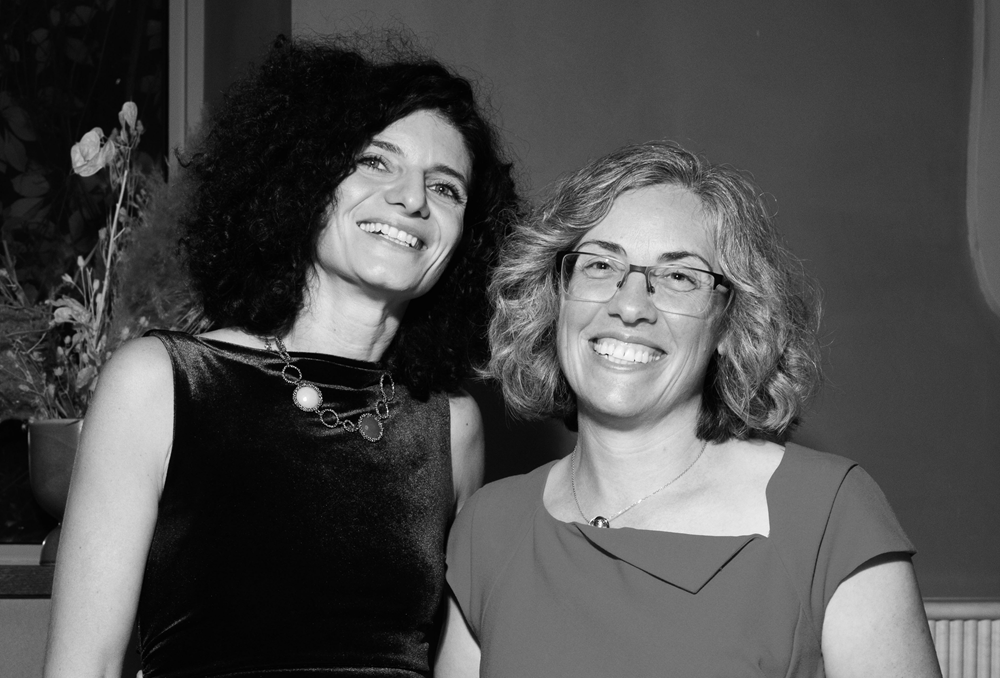
In time for this year’s International Women’s Day on 8 March, we sat down with our two Co-Founders Emanuela Maggioni and Marianna Obrist for an interview to discuss their journey from academia to startup.
Hynt Co-Founders Ema and Marianna have known each other for 10 years, having first met in 2016 when they worked together on a project on sensory experiences in virtual reality environments. Ema’s academic specialisation in cognitive psychology and olfactory science, and Marianna’s in human-computer interaction and technology, coupled with a focus on multisensory experience, complemented each other perfectly. After that initial project in 2016, their respective work coalesced on several research projects over the following years. In 2019, while working at the University of Sussex, they had just patented a software toolkit for designing smell experiences. Both Ema and Marianna knew there was a market for their product. However, neither had previous commercial experience and, as two women in a male-dominated field, they faced an uphill battle. Let’s find out more about their journey from academic to startup sucess.
Ema and Marianna, you’ve both moved from the world of academic research into building a company. What was the single hardest thing you had to unlearn in order to make that transition work?
Ema: Well, for me, receiving an Enterprise Fellowship from the Royal Academy of Engineering in the early days was crucial. Moving from academia to industry was one of the steepest learning curves I have ever had to climb – and the Academy provided not only the tools but also the personalised support that helped us navigate completely new territory. At the beginning, there was so much we didn’t know, but that was also incredibly energising. Since then, I’ve also really benefited from the Frontier Innovation Fellowship, which has provided lots of practical support and access to networks. But if I had to name one key shift, it was learning to embrace uncertainty and make decisions without having all the answers upfront, which is very different from academia.
Marianna: I would say one of the most important shifts was learning to better understand the perspective of VCs and investors, where science isn’t always the central focus in the same way it is for us. Science is at the core of everything we do at Hynt, but we have had to learn to adjust how we communicate that. In practice, it’s meant expanding our perspective and connecting our scientific work to vision, impact and business potential. We have been finding ways to stay true to our scientific principles while also building something that can thrive in the real world.
Ema: Yes! I think Marianna makes a really good point. We’ve had to learn to speak the startup and investment language – and kind of unlearn academia speech.
When you look at the problem Hynt’s technology solves, who is the person you most want to help – and when did you first realise that person wasn’t being served well enough by what already existed?
Ema: For me, it is people who struggle to truly rest and disconnect in a world that constantly stimulates them. During my research, I realised that smell is almost completely overlooked in wellness and health technology, despite it being so central to our wellbeing. Not only that, but while there are plenty of sleep trackers out there, very few offer ways to improve the user’s sleep. I saw an opportunity to create a product that fills both of those gaps – using scent to improve users’ sleep and boost their wellbeing.
Marianna: Beyond our customers, the person I most want to help is Ema. I have had the privilege of witnessing her grow and lead over the past decade. She has the vision and determination to build something that can genuinely improve people’s lives, and I want to help ensure she has every opportunity to make that happen.
The pressure on women in tech to prove themselves twice over before being taken seriously is well documented. Have there been moments where you’ve faced resistance or reluctance – and how did you overcome that?
Marianna: Yes, there’s definitely been experiences that required a bit of a rant over a drink afterwards. I’d love to share a few specific instances, but you can probably appreciate that we also have to be a bit mindful with this. So, instead, let me maybe just say that, frustrating though those experiences are, they have helped us grow stronger and more intentional. They pushed us to refine our voice, build the right partnerships, and stay focused on people who truly understand and support our vision. I am very much a glass-half-full person, and I see those moments as part of building resilience.
Ema: I’ll mention one experience! We were on a call with an investor and, when I had finished explaining our work, he goes, ‘Oh, so I bet you smell really nice’. I don’t think he’d have said that to another man. But I think those moments, while challenging to navigate at the time they occur, have also been incredibly clarifying. They have taught me to trust my expertise and stand firmly behind our work. Over time, I have learned that confidence grows through experience and that persistence really matters. What has made the biggest difference is surrounding ourselves with people and communities who believe in what we are building.
You’re building something together. Every co-founder partnership has moments of tension or miscommunication. Can you tell us about how you’ve learned to tackle these challenges and grow from the experience?
Ema: We are closely aligned in our vision and values, which makes a huge difference. And while we both have strong scientific depth, what really differentiates us is how we approach things. I tend to be more instinctive and exploratory, while Marianna brings a very structured and organised approach to our work. I really think these differences complement each other, and make us a stronger team.
Marianna: Yes, we are very well aligned in our vision, which makes everything easier. We think in similar ways, even if we express it differently. And I think, after ten years of working together, I have learned how to translate some of Ema’s more instinctive thinking into more structured action. That is where we really complement each other.
If a young person in their final year of a science or engineering degree is reading this right now and wondering whether to stay in research or take the leap into building something – what do you wish someone had told you, and what would you tell them now?
Marianna: I would say connections and relationships are everything. Build and nurture your network, even if you can’t quite see how it might all fit together one day. And then, find the right person – or people – for your journey. If you are aligned on things like values and aspirations, you’ll be able to stay on course through all the detours and obstacles you’ll inevitably face along the way. And it helps if you enjoy their company!
Ema: I wish someone had told me that you do not need to have everything figured out from the beginning. It’s okay to take the leap before you feel completely ready. Building something from science can feel uncertain, but it is also incredibly meaningful. Trust your curiosity, trust your voice, and remember that your perspective has value. Science needs people who are willing to carry it beyond the lab and out into the world.
Thanks so much to the both of you for taking the time to talk to us today. We’ve also filmed a version of this interview for Instagram, so just a quick note to readers that they can see and hear more from Ema and Marianna over on that channel.